AP Periph CAN node L431
1. Product Overview
1.1. Product Description
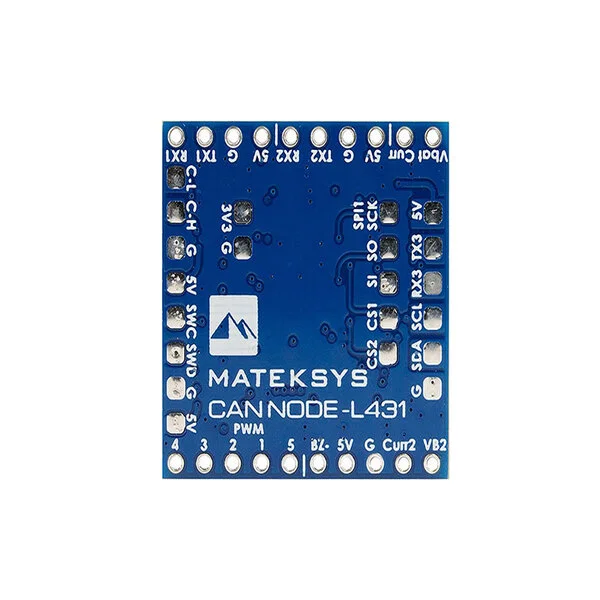
The Matek AP_Periph CAN Node L431 is a compact and versatile DroneCAN peripheral node based on ArduPilot AP_Periph firmware. It provides an interface for sensors, GPS, airspeed, and other peripherals through the DroneCAN network, allowing streamlined wiring and modular UAV system design. Equipped with an STM32L431 MCU, multiple UART/I2C/SPI ports, and analog inputs, it serves as a flexible node for advanced UAV architectures.
1.2. Key Features
- Fully compatible with ArduPilot AP_Periph firmware.
- Supports DroneCAN/CAN Bus protocol with high-speed data communication.
- MCU: STM32L431xC with 256 KB Flash memory.
- Input voltage: 4.5 – 5.5 V (5V pad).
- Power consumption: approximately 40 mA.
- 1 × CAN port (dual JST-GH connectors in parallel).
- 3 × UART ports for GPS, MSP, or other serial peripherals.
- 1 × I2C port for barometer, compass, or airspeed sensors.
- 1 × SPI port for high-performance sensors (e.g., RM3100 compass).
- 4 × ADC channels (battery voltage and current inputs).
- LED indicators for power and status monitoring.
- Firmware upgradeable via DroneCAN GUI Tool.
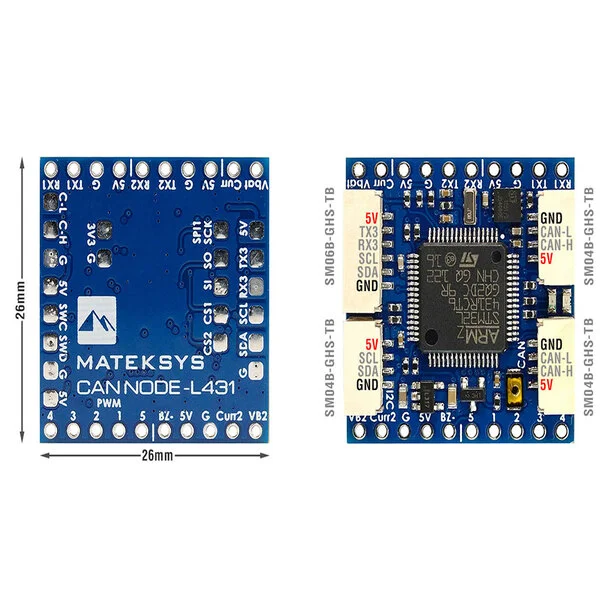
- Compact design: 26 × 26 × 6 mm, weight: ~3.7 g.
2. Technical Specifications
Table 2-1. Matek AP_Periph CAN Node L431 Specifications
| Parameter | Specification |
|---|---|
| Model | AP_Periph CAN Node L431 |
| Firmware | ArduPilot AP_Periph (DroneCAN node) |
| Processor | STM32L431xC, 256 KB Flash |
| Communication | DroneCAN/CAN Bus up to 5 Mbit/s (CAN FD supported) |
| CAN Ports | 1 × CAN (dual JST-GH connectors in parallel) |
| UART Ports | 3 × UART (UART1, UART2, UART3) |
| I2C Port | 1 × I2C for sensors and peripherals |
| SPI Port | 1 × SPI for advanced sensors |
| ADC Channels | 4 × analog inputs (e.g., voltage, current monitoring) |
| Input Voltage | 4.5 – 5.5 V |
| Power Consumption | ~40 mA typical |
| Operating Temperature | -20°C to +80°C |
| Dimensions | 26 × 26 × 6 mm |
| Weight | ~3.7 g |
| Status LEDs | Blue (boot/work status), Red (3.3 V indicator) |
| Firmware Upgrade | DroneCAN GUI Tool via CAN network |
3. Applications
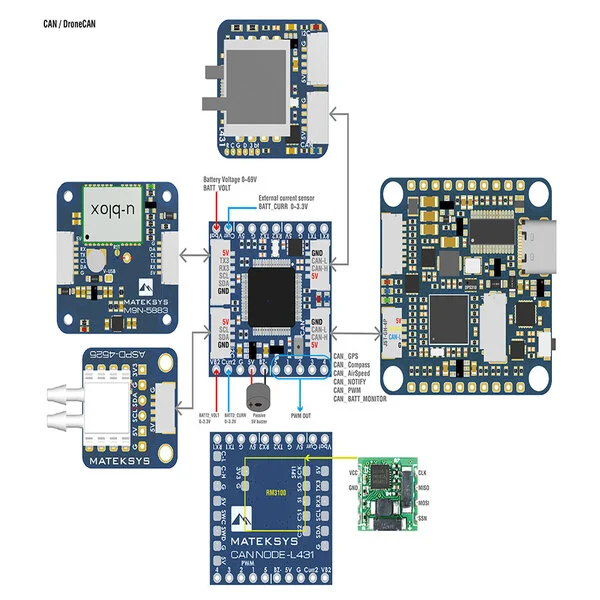
- UAVs & Drones: Connects GPS, airspeed, barometer, compass, and other sensors via CAN network.
- Robotics: Integrates traditional UART/I2C sensors into DroneCAN ecosystems.
- Distributed Systems: Reduces wiring complexity using a modular CAN-based approach.
- Telemetry Nodes: Enables power monitoring through ADC-based voltage/current measurement.
4. Pinout and Ports
- CANH / CANL: DroneCAN communication lines.
- 5V: Main power input (4.5 – 5.5 V).
- UART1 / UART2 / UART3: Serial communication for GPS, MSP, or telemetry.
- I2C: Connects barometers, compasses, or airspeed sensors.
- SPI: For high-speed sensors like RM3100 compass.
- ADC: Analog inputs for battery voltage/current monitoring.
- GND: Ground connection.
5. Setup and Integration
- Connect the CAN port to the flight controller DroneCAN network.
- Power the node with 4.5 – 5.5 V on the 5V pad.
- Configure the node ID and baud rate using DroneCAN GUI Tool.
- Attach peripherals through UART, I2C, or SPI as required.
- Ensure proper CAN bus termination and wiring integrity.
- Update firmware using DroneCAN GUI Tool for latest compatibility.
6. Advantages
- Compact and lightweight for flexible UAV installation.
- Full support for DroneCAN/CAN bus integration.
- Multiple peripheral ports for GPS, sensors, and telemetry devices.
- Supports AP_Periph firmware variants (default, airspeed, etc.).
- Simple setup and firmware upgrade process via CAN network.
7. Limitations and Notes
- Ensure proper firmware variant for the intended peripheral use.
- Reported parameter saving issues in early firmware versions — update recommended.
- Not all peripheral drivers are supported by all firmware builds.
- Requires proper CAN bus termination for reliable communication.
- Limited UART/I2C ports — complex setups may require multiple nodes.
8. Practical Summary
The Matek AP_Periph CAN Node L431 is a versatile DroneCAN-compatible peripheral board designed for UAVs and robotics using ArduPilot. It integrates multiple sensor interfaces, high-speed CAN communication, and low power consumption in a compact form. Perfect for modular and distributed UAV systems, it simplifies wiring and extends functionality through the DroneCAN network with reliable performance and flexible configuration options.
There are no reviews for this product.
There are no reviews for this product, be the first to leave your review.
No questions about this product, be the first and ask your question.